new

Get trending papers in your email inbox!

Subscribe

Trending Papers

byAK and the research community

Trending Papers

PaperOrchestra: A Multi-Agent Framework for Automated AI Research Paper Writing

PaperOrchestra is a multi-agent framework that converts unstructured research materials into complete LaTeX manuscripts with literature synthesis and visual elements, outperforming existing autonomous writing systems in human evaluations.

  • 4 authors
· Apr 6, 2026
Submitted by
amael-apple

Depth Pro 2: Sharp and Temporally Consistent Metric Monocular Depth

A single scalable network estimates dense metric depth for images and video at native resolution, jointly improving metric accuracy, boundary sharpness, and temporal consistency.

apple Apple · Nov 19, 2026
Submitted by
iTheresaApocalypse

Gamer: A Generalist Vision-Language-Action Foundation Model for Long-Horizon Real-Time Game Agent

Gamer is a generalist agent framework that integrates perception, memory, and multi-step reasoning, trained through continued pre-training, sparse-thinking instruction tuning, and multi-turn reinforcement learning to interact efficiently in 2D and 3D environments.

  • 27 authors
· Nov 13, 2026
Submitted by
aaronjli

TokenEconomizer: Experience-Driven Black-Box Cost Control for Coding Agents

TokenEconomizer reduces recurring token costs of coding agents across sequential real-world tasks by pruning irrelevant tools, injecting micro-skills, and interrupting failure loops.

MicrosoftResearch Microsoft Research · Oct 15, 2026
Submitted by
ghy0324

π^4: A Foundation Model for 4D Scene Geometry and Motion

This unified foundation model enables the recovery of dense geometry, camera poses, and object tracking from diverse, uncalibrated observations in 4D scenes using a shared geometry and motion branch architecture.

Shanghai-AI-Laboratory Shanghai AI Laboratory · Nov 17, 2026

TradingAgents: Multi-Agents LLM Financial Trading Framework

A multi-agent framework using large language models for stock trading simulates real-world trading firms, improving performance metrics like cumulative returns and Sharpe ratio.

  • 4 authors

· Dec 28, 2024
Submitted by
bupalinyu

The Other Half of the Memory Wall: Serving 35B MoEs from SSD with Trained Routing Prediction

Edge0 enables efficient mixture-of-experts inference on consumer hardware by predicting expert routing ahead of time and using recovery adapters to maintain quality with minimal active memory.

Edge0 Edge0 · Sep 16, 2026

Bitnet.cpp: Efficient Edge Inference for Ternary LLMs

Bitnet.cpp enhances edge inference for ternary LLMs using a novel mixed-precision matrix multiplication library, achieving significant speed improvements over baselines.

  • 10 authors
· Feb 17, 2025
Submitted by
ruiyaox

Harness^2: Recursive Agent Harnessing for an Open World

Harness² improves agent execution harnesses through recursive task-level refinement and continual harness-level learning, boosting performance across benchmarks without ground-truth verifiers.

google Google · Oct 9, 2026
Submitted by
akhaliq

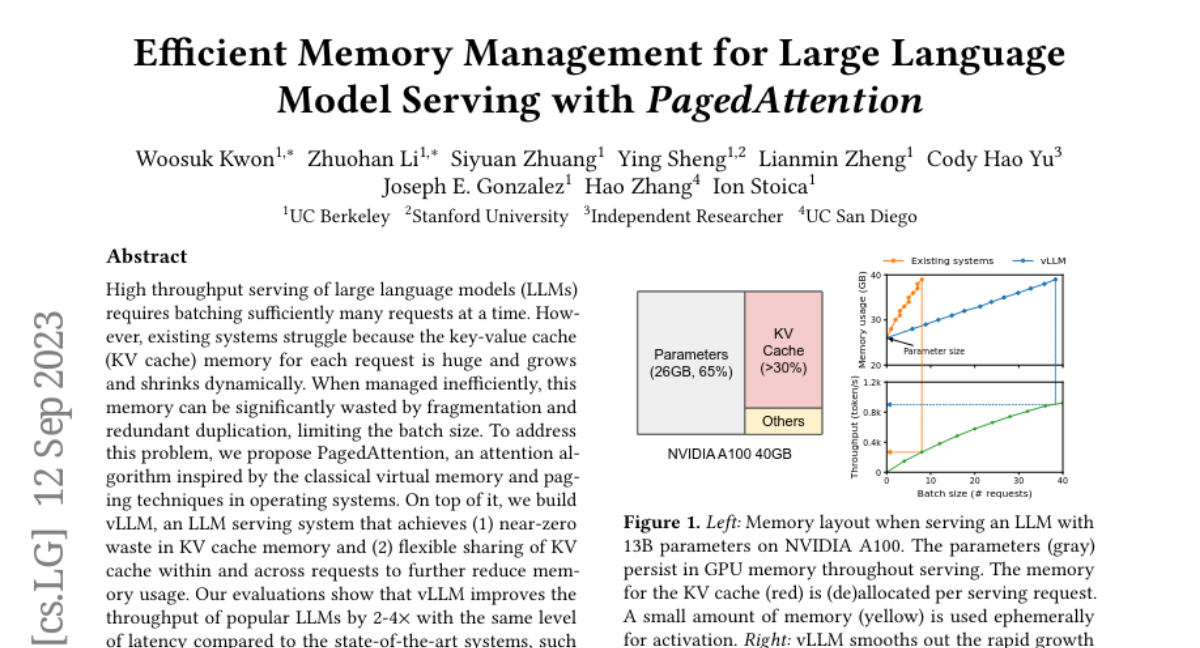
Efficient Memory Management for Large Language Model Serving with PagedAttention

PagedAttention algorithm and vLLM system enhance the throughput of large language models by efficiently managing memory and reducing waste in the key-value cache.

  • 9 authors
· Sep 12, 2023
Submitted by
akhaliq

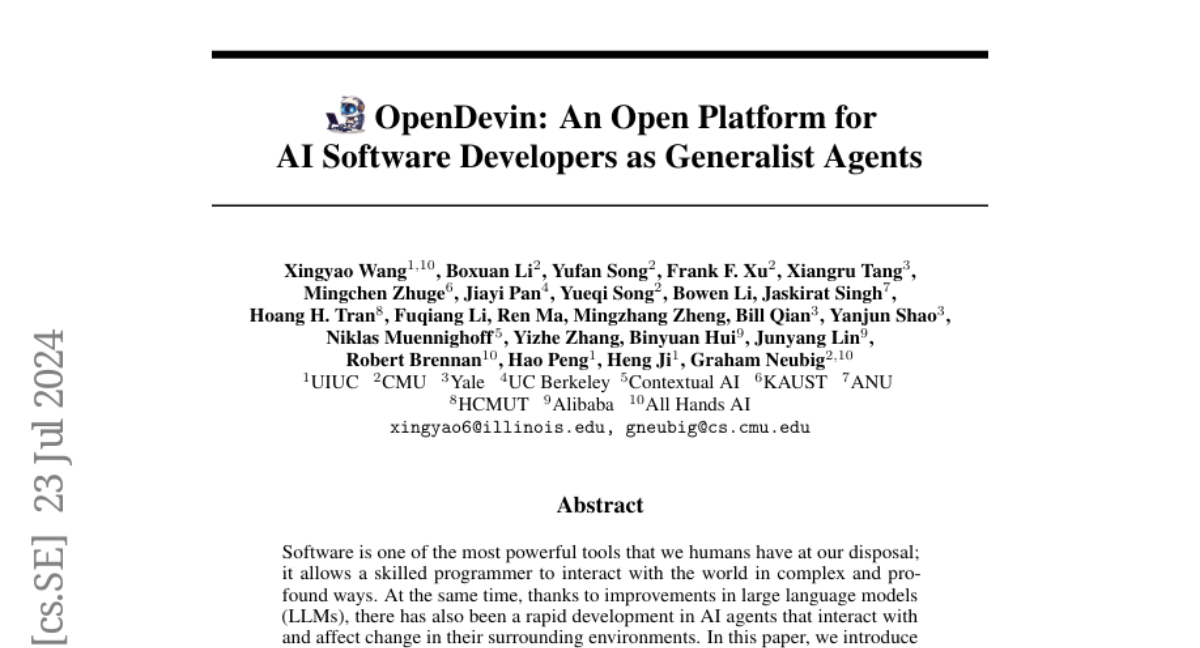
OpenDevin: An Open Platform for AI Software Developers as Generalist Agents

OpenDevin is a platform for developing AI agents that interact with the world by writing code, using command lines, and browsing the web, with support for multiple agents and evaluation benchmarks.

  • 24 authors

· Jul 23, 2024
Submitted by
andy-yang

FreeToken: Efficient Edge-Native MoE Serving with Bandwidth-Adaptive Execution

FreeToken is an edge-native Mixture-of-Experts serving system that dynamically maps computation and model state onto heterogeneous local hardware to run large open-weight models on personal machines.

Submitted by
akhaliq

Very Large-Scale Multi-Agent Simulation in AgentScope

Enhancements to the AgentScope platform improve scalability, efficiency, and ease of use for large-scale multi-agent simulations through distributed mechanisms, flexible environments, and user-friendly tools.

  • 8 authors
· Jul 25, 2024
Submitted by
taesiri

AgentScope 1.0: A Developer-Centric Framework for Building Agentic Applications

AgentScope enhances agentic applications by providing flexible tool-based interactions, unified interfaces, and advanced infrastructure based on the ReAct paradigm, supporting efficient and safe development and deployment.

  • 23 authors
· Aug 22, 2025

LittleBit: Ultra Low-Bit Quantization via Latent Factorization

LittleBit is a novel method for extreme compression of large language models using low-rank factorization and multi-scale compensation, achieving significant memory reduction and performance in sub-1-bit quantization.

  • 4 authors
· May 30, 2025
Submitted by
taesiri

MinerU2.5: A Decoupled Vision-Language Model for Efficient High-Resolution Document Parsing

MinerU2.5, a 1.2B-parameter document parsing vision-language model, achieves state-of-the-art recognition accuracy with computational efficiency through a coarse-to-fine parsing strategy.

  • 61 authors
· Sep 26, 2025
Submitted by
Changli

WeMM-Video: Pushing the Frontiers of Open-Source Omni-Modal Video Understanding

WeMM-Video is a family of Chinese-English bilingual omni-modal foundation models that unify text, image, audio, and video processing for joint audio-visual perception and reasoning, using hybrid thinking modes and large-scale training to achieve strong open-source video understanding results.

tencent Tencent · Nov 19, 2026
Submitted by
nielsr

Geometric Context Transformer for Streaming 3D Reconstruction

LingBot-Map is a feed-forward 3D foundation model that reconstructs scenes from video streams using a geometric context transformer architecture with specialized attention mechanisms for coordinate grounding, dense geometric cues, and long-range drift correction, achieving stable real-time performance at 20 FPS.

robbyant Robbyant · Apr 15, 2026
Submitted by
unilm

VibeVoice Technical Report

VibeVoice synthesizes long-form multi-speaker speech using next-token diffusion and a highly efficient continuous speech tokenizer, achieving superior performance and fidelity.

MicrosoftResearch Microsoft Research · Aug 26, 2025
Submitted by
RuofengYang

ARIS: Autonomous Research via Adversarial Multi-Agent Collaboration

ARIS is an open-source research harness that uses cross-model adversarial collaboration to ensure reliable long-term research outcomes through coordinated execution, orchestration, and assurance layers.

Submitted by
akhaliq

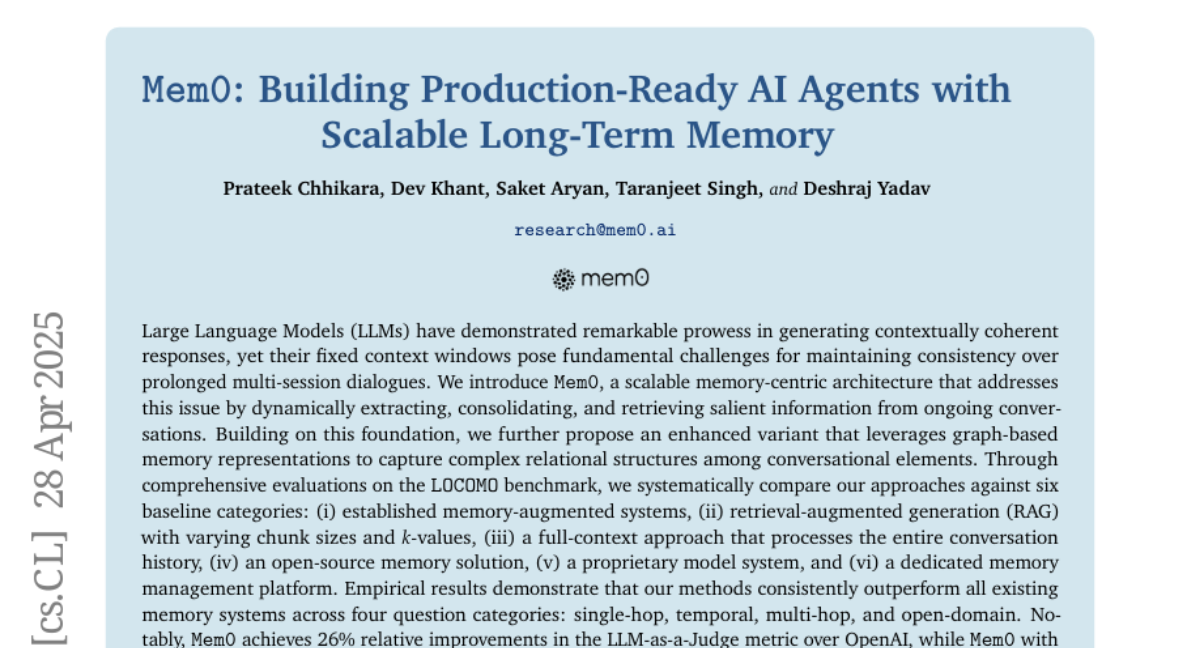
Mem0: Building Production-Ready AI Agents with Scalable Long-Term Memory

Mem0, a memory-centric architecture with graph-based memory, enhances long-term conversational coherence in LLMs by efficiently extracting, consolidating, and retrieving information, outperforming existing memory systems in terms of accuracy and computational efficiency.

  • 5 authors
· Apr 28, 2025

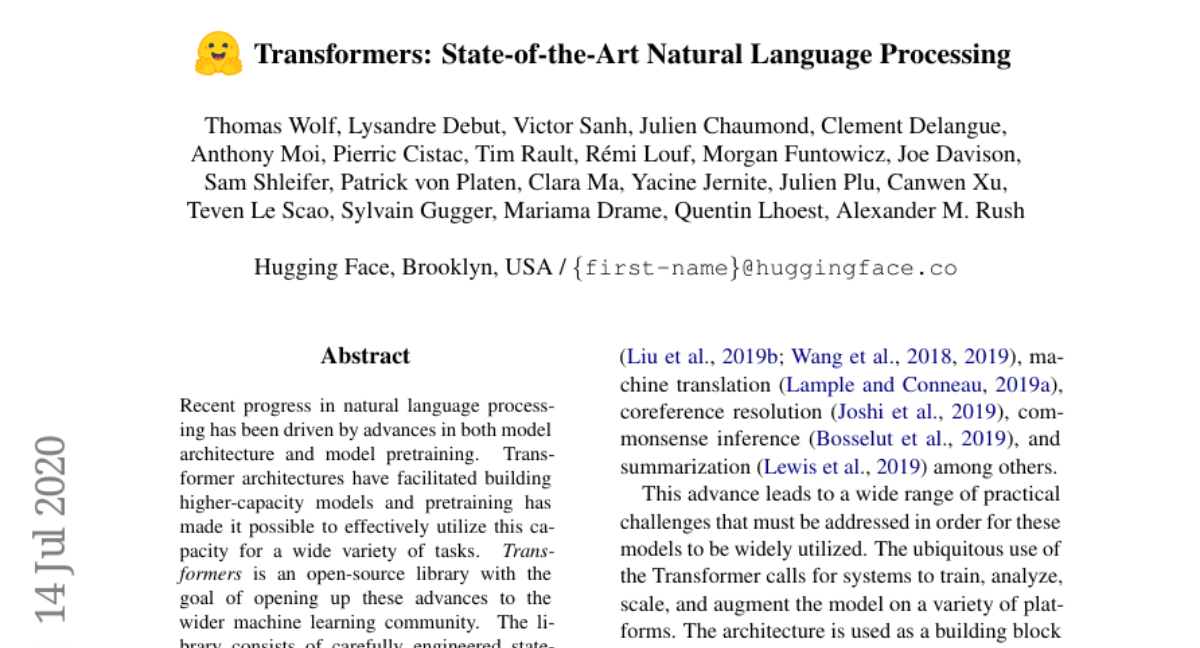
HuggingFace's Transformers: State-of-the-art Natural Language Processing

Transformers library provides state-of-the-art Transformer architectures and pretrained models for natural language processing tasks with a unified API and emphasis on extensibility and robust deployment.

huggingface Hugging Face · Oct 9, 2019
Submitted by
yunyangge

MovieRoll: A Systematic Framework for Rolling Out Long-Form Videos

Streaming video generation must sustain quality beyond the training horizon while handling self-generated history and growing cache costs. To address these challenges, we present MovieRoll, a base-to-distilled framework that connects streaming fine-tuning, long-rollout distillation, and long-horizon inference. We first establish a robust multi-step base through Window-wise Teacher Forcing (WinTF), which jointly denoises chunks at progressive noise levels with bidirectional attention within each window and causal access to preceding history. To retain historical context efficiently, hierarchical KV-cache compression (HieraKV) exploits layer-wise attention patterns, retaining full history in shallow layers and sink--recent history in deeper layers. This reduces cache memory by up to 78% while improving generation quality. Building on this base, cumulative long tuning with distribution matching distillation (CuLT-DMD) holds parameters fixed throughout each long self-rollout and averages local gradients before updating. Each update therefore combines supervision across temporal positions while retaining only one local computation graph, enabling efficient long-rollout training of a few-step generator. To extend generation beyond the training horizon, KV recomputation bounds context for both models, while guidance annealing (AnnealCFG) reduces guidance toward the clean endpoint to stabilize MovieRoll-Base. Complementing these modeling advances, FBCA attention and PS-VAE decoding support efficient training and streaming output. On HeliosBench, MovieRoll-Base remains competitive at 30s after training on videos of up to 15s, and MovieRoll-Distilled achieves the highest total scores among the compared methods across single- and multi-event evaluations up to 60s, combining sustained naturalness with active motion.

  • 12 authors
· Nov 16, 2026
Submitted by
linlinlinlinsdada

Jeveration: System One Models Now Generate

Jeveration repurposes a frozen vision-language model to generate coherent images and perform image-to-image and dense prediction tasks in a single forward pass with fast 512x512 generation.

Kronos: A Foundation Model for the Language of Financial Markets

Kronos, a specialized pre-training framework for financial K-line data, outperforms existing models in forecasting and synthetic data generation through a unique tokenizer and autoregressive pre-training on a large dataset.

  • 7 authors
· Aug 2, 2025
Submitted by
ChengCui

PaddleOCR-VL-1.6: Expanding the Frontier of Document Parsing with Under-Optimized Region Refinement and Progressive Post-Training

PaddleOCR-VL-1.6 enhances document parsing performance through targeted data optimization and progressive post-training techniques, achieving state-of-the-art results on OmniDocBench v1.6.

PaddlePaddle PaddlePaddle · Jun 2, 2026
Submitted by
Karl28

MedJev: A System One Vision-Language Decision Model for Fast and Effective Medical Image Understanding

Medical image understanding with vision-language models (VLMs) typically relies on autoregressively generating reasoning and answer tokens. These unnecessary tokens make the inference cost scale with the response length and force the answer to be parsed from free-form text, incurring avoidable latency and decision errors. To this end, we introduce MedJev, a system one vision-language decision model that maps medical images, questions, and candidate answers directly to decisions in a single multimodal forward pass, without any autoregressive generation process. For fast inference, MedJev removes the upper language layers and the generative output pathway, while keeping the full vision pathway and all visual tokens. On this shortened backbone, a decision head scores each candidate by pretrained query--key matching and refines the scores with a lightweight multilayer perceptron (MLP) residual, coupling the pretrained matching structure with task-specific nonlinear discrimination. Built on Qwen3.5-4B, MedJev-4B improves both accuracy and speed over the original model on each of four medical image classification and visual question answering benchmarks, with an absolute accuracy gain of 7.93\% and a 6.04times end-to-end speedup. Further comparison with 20 cutting-edge models shows that MedJev-4B achieves state-of-the-art performance and inference speed among 4B--9B general and medical VLMs, indicating that direct multimodal decision making is an effective route to fast and effective medical image understanding.

Submitted by
andito

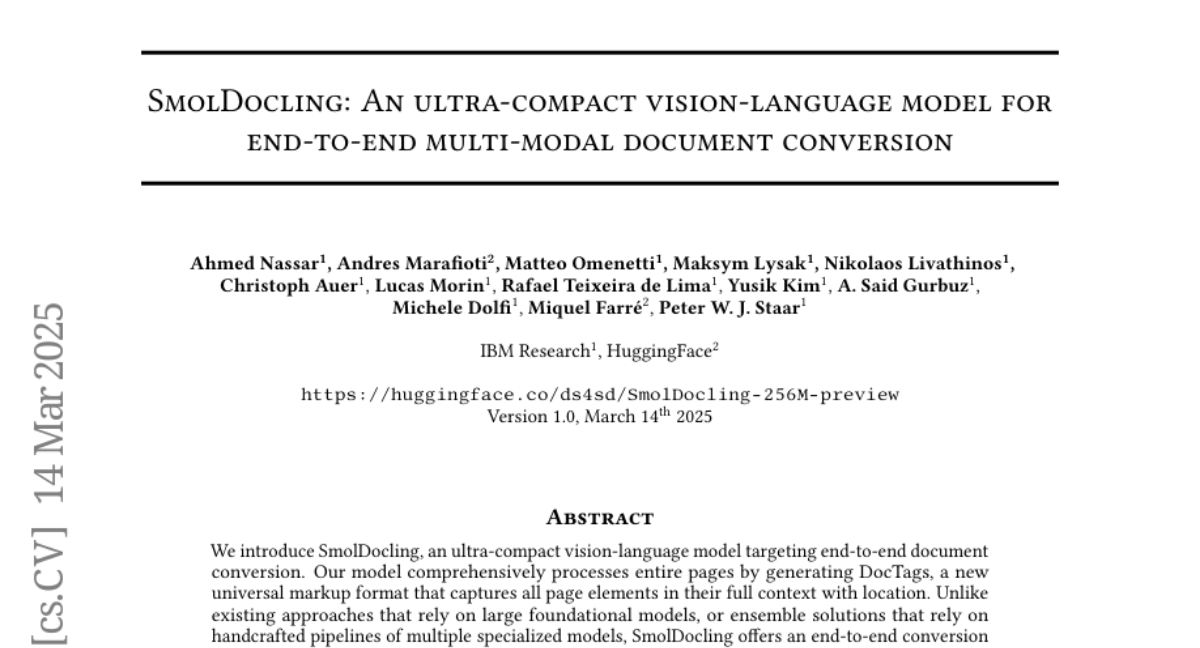
SmolDocling: An ultra-compact vision-language model for end-to-end multi-modal document conversion

SmolDocling is a compact vision-language model that performs end-to-end document conversion with robust performance across various document types using 256M parameters and a new markup format.

ibm-granite IBM Granite · Mar 14, 2025

Native and Compact Structured Latents for 3D Generation

A new sparse voxel representation called O-Voxel enables high-quality 3D generative modeling with efficient inference and robust topology handling.

microsoft Microsoft · Dec 16, 2025
Submitted by
akhaliq

Drag Your GAN: Interactive Point-based Manipulation on the Generative Image Manifold

DragGAN enables precise user-controlled manipulation of image content through interactive point dragging, improving realism and flexibility over existing GAN-based methods.

  • 6 authors
· May 18, 2023

PyTorch Distributed: Experiences on Accelerating Data Parallel Training

The PyTorch distributed data parallel module optimizes large-scale model training using techniques like gradient bucketing, computation-communication overlap, and selective synchronization to achieve near-linear scalability.

  • 11 authors
· Jun 28, 2020
Submitted by
cherubicxn

Learning Heterogeneous Tactile Representation for General Dexterous Manipulation

LingBot-Touch is a tactile foundation model that learns a unified, extensible representation across heterogeneous tactile sensors, yielding plug-and-play tactile tokens that consistently enhance manipulation policies such as diffusion policy and VLA models.

robbyant Robbyant · Nov 9, 2026
Submitted by
hzxllll

ZeroVLN: Learning to Navigate without Supervised Fine-Tuning of the VLM Brain

ZeroVLN is a slow-fast vision-language navigation framework that avoids navigation-domain supervised fine-tuning of the VLM brain by using a semantic tool-calling interface and closed-loop reinforcement learning to coordinate a language-based brain with an action expert, improving VLN-CE performance while preserving general visual capabilities.

ZYT-AI ZYT AI Team · Nov 19, 2026
Submitted by
cheese1

Code World Model 2.0: Towards Infinite Controllable Video Generation

Visual proxies decouple explicit world-state simulation from photorealistic video synthesis, offering a controllable interface for both offline clip creation and real-time interactive streaming. Yet a practical renderer must address two challenges. Upstream proxies vary from coarse layouts to fine articulated geometry depending on the interaction, and streaming inference must operate in a few causal steps without accumulating drift across self-generated history. We present Invoker-Render, pairing a bidirectional creation model with a causal four-step streaming model under a shared conditioning interface over structural proxies, an appearance reference, and language. Trained on an aligned approximately 200-hour multi-granularity corpus, Invoker-Render honors fine geometric constraints when supplied while synthesizing plausible local motion under coarse proxies, enabling runtime selection of input detail. To bridge bidirectional creation and real-time streaming without compounding step compression and rollout drift, we introduce Progressive Forcing (ProForcing). ProForcing first trains a causal predictor and distills it into a four-step renderer using histories derived from training videos. Training then shifts to continuous self-generated rollouts. A pipelined serving stack supports efficient streaming inference. Experiments show versatile control across proxy families, granularities, and camera paths, consistent gains over recent streaming baselines, and stable 30-minute racing rollouts that preserve scene and subject appearance.

inclusionAI inclusionAI · Nov 17, 2026
Submitted by
GuoxinChen

AutoMaster: Autonomous Post-Training by Making the Same Model a Better Teacher

Task success alone does not specify which behaviors post-training should reinforce. Even successful teacher trajectories can contain unsupported assumptions, unproductive repetition, or superficial verification. We propose Skill-FT (Skill-Guided Fine-Tuning), which uses natural-language skills to suppress undesirable habits and elicit underrepresented effective behaviors during teacher rollouts, then fine-tunes a target model on the resulting trajectories. We introduce AutoMaster, an autonomous post-training system in which an LLM agent develops these interventions through trajectory analysis, skill design, data selection, and feedback from rollouts and target-model evaluation. Across Terminal, Search, and software engineering tasks with 4B and 9B target models, AutoMaster improves mean performance over Vanilla SFT on successful unguided teacher trajectories by 1.42-8.99 percentage points, with the teacher, task pool, training set size, and SFT recipe held fixed. Together with the ablations and trajectory analyses, these results suggest that behavioral shaping can make a fixed model a more effective teacher. We further find that retaining skill instructions during SFT yields higher mean performance than removing them across all six settings, despite their absence at evaluation and identical supervised outputs. These findings suggest that preserving skill context as part of a training demonstration can support better behavioral internalization.

RUC-AIBOX RUC-AIBOX · Nov 19, 2026
Submitted by
gene-chou

FastFrames: Video Generation at Interactive Latency

Autoregressive video diffusion models generate frames based on new observations and inputs, making them a promising medium for interactive visual experiences. However, existing models are orders of magnitude too slow for fluid interaction. This paper introduces FastFrames, a family of fast autoregressive video diffusion models that achieves interactive latency without compromising quality. We profile the inference pipeline of state-of-the-art models and find that operations often treated as fixed implementation details, such as VAE decoding and KV cache updates, in fact account for over half of end-to-end inference latency. We challenge the assumption that these components are indispensable and replace them with lightweight alternatives. Our 1.3B variant runs at 36 ms per frame, or 28 responses per second (RPS), on a single B200 GPU while matching the generation quality of a state-of-the-art model that is nearly 8x slower. Our 14B variant runs at 45 ms per frame, or 22 RPS, on an 8x B200 GPU node and yields significantly better visual quality and realism. We show that FastFrames enables real-time interaction in applications such as camera-conditioned and physics-conditioned video generation.

apple Apple · Nov 17, 2026
Submitted by
AnonMegumi

WeVisForensics: Self-Evolving Agent for Omni AI-Generated Video Detection

WeVisForensics coordinates self-evolving visual and audio forensic inspector agents under a dual-timescale reinforcement learning policy to detect generated-video artifacts with localized evidence and high accuracy.

tencent Tencent · Nov 16, 2026
Submitted by
nielsr

Ultralytics YOLO26: Unified Real-Time End-to-End Vision Models

YOLO26 addresses real-time vision challenges through a unified model family with NMS-free inference, improved training strategies, and multi-task capabilities spanning detection, segmentation, and pose estimation.

Ultralytics Ultralytics · Jun 2, 2026

OmniFlatten: An End-to-end GPT Model for Seamless Voice Conversation

A novel GPT-based model, OmniFlatten, enables real-time natural full-duplex spoken dialogue through a multi-stage post-training technique that integrates speech and text without altering the original model's architecture.

  • 9 authors
· Oct 23, 2024
Submitted by
jasonrqh

COLLEAGUE.SKILL: Automated AI Skill Generation via Expert Knowledge Distillation

Person-grounded AI skills are automatically distilled from heterogeneous traces into inspectable, correctable packages that capture both capabilities and behavioral patterns.

ShanghaiAiLab shanghai ailab · May 29, 2026
Submitted by
csjiaya

InCoder-32B: Code Foundation Model for Industrial Scenarios

InCoder-32B is a 32-billion-parameter code model trained on industrial datasets with extended context length and execution verification to improve performance in hardware-aware programming tasks.

Beihang Beihang University · Mar 17, 2026
Submitted by
swa2n

e-means: outperforming k-means (in one-tenth the epochs)

Lloyd's k-means algorithm is a long-running standard for clustering, with applications in data analysis, retrieval, quantization and data curation. In this paper, we introduce an exponential moving average optimization procedure for k-means with mini-batch updates, powered by modern deep learning machinery and new insights. We also establish scaling laws on how decay rate and batch size impact final performance. This gives us a formulaic rule to fix them for multiple problem sizes and embedding datasets, without the need for any hyperparameter sweep. The resulting clustering algorithm, coined e-means, is much faster than Lloyd k-means and converges to lower losses, frequently even beating k-means++. On a wide array of embeddings datasets, it beats the loss of Lloyd k-means at 25 epochs in 1.4 to 2.6 epochs, which translates to 10-45x GPU wall-clock speedups compared to state-of-the-art k-means implementations. As an example, e-means partitions DINO10B, a dataset of 10 billion DINO embeddings, into 16 million clusters in only 2.5 epochs, reaching a loss below Lloyd's at 25 epochs.

meta Meta · Nov 6, 2026
Submitted by
guanwenhao

VoxMel TTS Technical Report

VoxMel is a tokenizer-free autoregressive TTS framework that uses an invertible two-axis Haar transform to decompose mel spectrograms into Coarse-Mel and residual tiers, enabling stable high-fidelity generation with strong recognition and speaker-similarity results.

VoxDance-Lab VoxDance-Lab · Nov 15, 2026
Submitted by
amael-apple

Sharp Monocular View Synthesis in Less Than a Second

SHARP synthesizes photorealistic views from a single image using a 3D Gaussian representation, achieving state-of-the-art results with rapid processing.

apple Apple · Dec 11, 2025
Submitted by
lhpku20010120

OmniEdu: Open Foundation Models for Learning and Teaching

OmniEdu is a family of instruction-tuned educational foundation models that improve K-12 problem solving, curriculum understanding, and tutoring through capability-balanced training data.

PekingUniversity Peking University · Sep 19, 2026
Submitted by
taesiri

Unlimited OCR Works

Unlimited OCR introduces Reference Sliding Window Attention to eliminate growing memory consumption during long-sequence OCR tasks, enabling efficient transcription of multiple pages in a single forward pass.

baidu BAIDU · Jun 22, 2026
Submitted by
taesiri

LongCat-Video Technical Report

LongCat-Video, a 13.6B parameter video generation model based on the Diffusion Transformer framework, excels in efficient and high-quality long video generation across multiple tasks using unified architecture, coarse-to-fine generation, and block sparse attention.

meituan-longcat LongCat · Oct 25, 2025
Submitted by
Rbin

RAG-Anything: All-in-One RAG Framework

RAG-Anything is a unified framework that enhances multimodal knowledge retrieval by integrating cross-modal relationships and semantic matching, outperforming existing methods on complex benchmarks.

Submitted by
a43992899

YuE2: Unifying Symbolic and Audio Music Generation at Frontier Quality

YuE2 unifies symbolic and audio music generation via symbolic planning, producing readable scores and full-song audio with state-of-the-art quality and agentic editing capabilities.

Zep: A Temporal Knowledge Graph Architecture for Agent Memory

Zep, a memory layer service, outperforms MemGPT in the DMR benchmark and LongMemEval by excelling in dynamic knowledge integration and temporal reasoning, critical for enterprise use cases.

  • 5 authors
· Jan 20, 2025